AROMATUM

May 11, 2019

Field Notes from Sicily; Family & Wild Fennel


Sicily has a beautiful color palette - at once soft and faded by the bright sun and the willful passage of time, contrasted against the searing blues of the Ionian sea and the bright pops of color from gelato, tomatoes, pistachio.
Last August we traveled abroad as a family for the first time. While we were nervous about traveling with an infant—how would we eat dinner? How would we adjust to a different rhythm?—Italy turned out to be the perfect choice, as the very culture is built around food and family. For one of our first meals in Tuscany we were greeted by a young man who was so thrilled we brought our tiny daughter to his family's restaurant that he told us to wait a moment and five minutes later came back pushing a baby carriage to introduce us to his infant son, Tiego, only 3 months old. We toasted the babies and enjoyed an incredible meal of wild boar, saffron infused applesauce and buttery Tuscan beans with rosemary.


When we arrived to Sicily we met up with our friends Chiara and Giovanni, whom we'd met five years prior on the side of a volcano in Bali. It just so happened that Mark, my boyfriend at the time, had planned a sunrise hike up the side of Mt. Batur, thinking it would be a very romantic place to ask a special question. While he thought we'd be alone, our guide introduced us to another couple whom we'd be hiking with in the dark - Chiara and Giovanni from Sicily. Needless to say we had a blast hiking up the basalt-covered mountainside, chattering away with these two (Mark with one hand in his pocket making sure not to misplace a certain round metal thing). When we got to the top and the sun began to peek over the horizon, Mark handed the camera to Chiara and asked her to take our photo. As she snapped a few shots, he pulled the ring out of his pocket and proposed. I burst into tears, and Giovanni, watching nearby, let out a string of American curse words and snapped some photos of his own, yelling excitedly ‘Cry! Cry!’


We stayed in touch and I promised we'd visit them in Sicily. While some promises made on trips fade into oblivion, this one didn’t. Chiara and I stayed in touch and after five years we finally made it, complete with our new +1, baby Linden. Chiara gave us a whirlwind tour of the villages at the base of Catania, where she grew up, followed by a tour of Giovanni's orange groves, where Linden inspected the ripening fruit of the red and blood orange trees twinkling in the August sun. December is harvest time - oh how I wish we could have slipped back there to enjoy the fruit! Giovanni plucked a few blossoms for us to mount in the air vents of our rental, and we enjoyed a late lunch of fried vegetables and pasta with local fennel sausage in a quiet village.
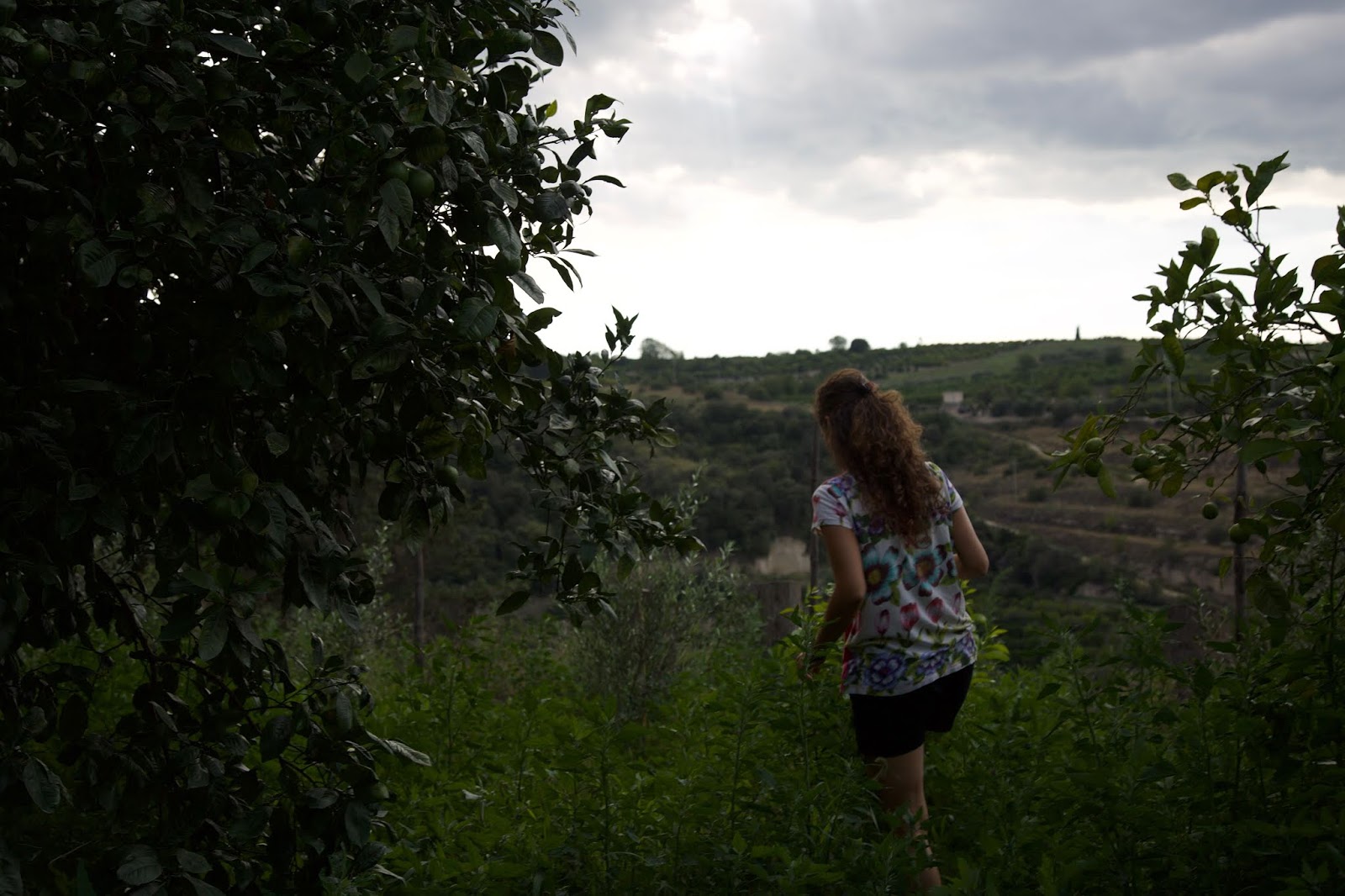


Our purpose for visiting Sicily was not only to reunite with our friends but to investigate some potential partnerships for Curio. I had been in touch with a farm in Ferla, SE Sicily, not far from Siracusa, where wild fennel grows in abundance. We arrived to the base of the farm, a beautiful compound run by a brother and sister complete with a fountain in the shape of a dolphin. They showed us their operation, which, while mostly centered on their award-winning olive oil, also featured an incredible array of aromatics that they harvest from the surrounding countryside. Their laboratory featured a giant photo of one of their children as a baby, like a mascot for the business. After a tour of the facility we piled into cars and headed out into the landscape so they could show us where they gathered the herbs and spices. It was late afternoon and the sun was beginning to dip over a dramatic landscape carved with limestone canyons - as we drove along I stared out the window and inhaled the sweet air and felt my body fill with peace.


We stopped along the edge of one of the canyons to get out and see the fennel transitioning from blossom to seed – it wasn’t ready to harvest just yet – and the earth seemed to be glowing chartreuse from the shoulder-high fennel plants. Katia explained how they were allowed to harvest from the park (the land is government protected), so long as they didn’t disturb the other plants and the overall eco-system. The fennel was everywhere, the air steeped in it. She explained how the limestone cliffs were historically significant for being made into an ancient cemetery: the Necropolis of Pantalica. We explored the edges of the park where the wild thyme grew on small spiky shrubs - so unlike the creeping thyme here in New England. And finally the sun sank too low and the baby began to cry and it was time to head to Giovanni’s mother’s house because she’d made us a pasta dinner.


Maurizio & Katia Marino

Mar 28, 2018

An Age Old Question ~ 3 Key Tips on Storing Spices


How long should I keep my spices?

We get asked this a lot in the shop and always have a couple ready answers. But the longer answer is something I've thought about a lot, and especially now, as spring knocks at the door, and my body and mind beg for freshness.

As some of you readers may know, I'm expecting a baby. This little one is exactly one week late now. I thought it'd be fun to have a baby on the "official" first day of spring, which is also Persian New Year (we did birth a new spice called Mazeh for Nowruz). But no baby. Now it's nearly Passover and Easter, and there are just so many holidays celebrating re-birth, liberation, spring and the like that it seems a darn well good time to celebrate a baby, too. If only he or she would budge from my womb.


Here's the short answer for how long you should keep your spices:

- Ground spices: 6 months is best. After 1 year, replace.
- Whole spices: 1-2 years.
- Dried herbs: 6 months.

If there isn't an obvious "best by" date on the package, mark your spices as soon as you buy them with the date. It will be easier to rotate them!

I collect antique spice packaging, but not antique spices.
But what's the longer answer?

Spices can and often do get forgotten. They are dried things from far away that are tucked away in a cabinet or drawer and brought out on occasion for a recipe for mapo tofu or gingerbread cake. There are a few favorites that stay out on the countertop for constant use, but my impression is that most homes contain a whole cast of spices that are ghosts of their former selves, lurking in a sort of shadowed, passive state.

I like this section from a Jorie Graham poem "To Mark Rothko" where she's writing about an intense color of red (here expressed through a description of a cardinal). I like it both because Rothko is a painter whose work speaks to me with its intense, emotional color (I went through a phase once of trying to express scent through color) but also because spices are often literally pigments themselves and are used in painting. Graham's poem captures the feeling of an intensity of color that I believe can be translated to spice:

He could fly now
into a moment of sunlight
that fell from the sun's edge
ten thousand years ago,
mixed in with sunlight
absolutely new.

The tradition of using spices in our food is ancient—traditions stemming from ritual and medicine dating back more than ten thousand years. But the flavors should be absolutely new; they should be the best dry-form expression that the plant has to offer, mixed in with sunlight. How intense are your spices? Are they Rothko intense? Sunlight is pretty intense, and it is something we eat, in a way, in that plants translate sunlight into sugars through photosynthesis. 


Here are 3 key ways to eat sunlight (and keep your spice cupboard fresh):

1) Relocate: Figure out which are your absolute desert-island favorite spices, and move those to a convenient spot in your kitchen - such as where you keep your salt and pepper or olive oil. It may be that you have just two (besides salt and pepper) or maybe ten. Figure it out. Your food will taste better because you'll use these more often.

2) Refresh: Spring cleaning isn't just for rugs and floors: go into your spice cupboard at least once a year and pull out the stale spices. How do you know they're stale?
- Open the jar and smell it. Does it spark inspiration? (a la Marie Kondo's 'spark joy') I know it's vague, but the smell of your spices should excite you. If not, they're not going to add anything to your food.
- Feel it. Is it very dry, almost sandy? Or rock hard? The aromatic oils are gone, and there is no life left in this spice. Say so long.
- Does the packaging look pretty outdated? Yes, you know you have a few of these. There are also expiration dates to check.
- Has the color vanished? Especially for herbs and dried chilies - if it's gone more brown or gray, there isn't much left of this spice. Compost away.

Dried Maras chile pepper: 2+ years old (on left) versus fresh.

Ground cardamom (vaguely fragrant, looks like floor sweepings) vs. vibrant whole pods. 

3) Replace: Notice if most of your spices are ground. If yes, consider replacing all of the pure ground spices with whole versions. Exceptions are ginger and cinnamon, although grating your own cinnamon is definitely worth it! (See below for a note on turmeric). Also good to keep fresh ginger root around.

Here are whole spices that you should always keep on hand in lieu of ground:

- Nutmeg. Pre-ground nutmeg is only good for 1-2 months due to very volatile oil content. Just get used to grating it - you'll love it!
- Cardamom. Pods or seeds.
- Fennel seeds.
- Coriander seeds.
- Cumin seeds (unless you happen to buy our freshly toasted & ground!)
- Cloves.
- Star Anise.
- Peppercorns (all types).

Grate your own nutmeg. 
Grind your whole spices quickly and easily in a mortar and pestle or in an electric coffee grinder. The flavor will be astoundingly different.


What about turmeric?

While turmeric can be found fresh in the grocery store these days, it's not entirely practical to buy it this way. If you are excited about discovering turmeric and its health-promoting properties, it's worth it to seek out a freshly ground turmeric. We have one from Sri Lanka that we grind in house that's phenomenal. We also just started offering local ground turmeric from a farm in Amherst, MA. How cool is that?!

What about blends?

Since I am a spice blender, of course I must advocate for the use of blends, which may seem contrary to my whole argument about fresh spices. But if you are using freshly-made blends (from small purveyors!) you are doing great. Blends from big-chain grocery stores, or that come in giant bottles ("but it was SO CHEAP!") or that are basically commodity spices, aren't worth using. I can assure you that they've been sitting in their 'ground state' for at least one year if not three, so you are already buying expired, stale spices.

Good blends (made by small purveyors, freshly ground) offer the chance to elevate a dish more easily than you might be able to with just pure spices. They are to be used liberally and often, not just for the pie you make once a year. Blends are rooted in cultural traditions, a sense of place, a culinary concept - they are there to make your job easier in the kitchen, to stretch your imagination and to make you feel like a pro.


Concerns over money and spices:

One thing that I think demotivates us from getting rid of spices is that they cost us money, and the possibility that they *might* still be good so "maybe I'll save money by keeping them around." But think of your spices like a bunch of fresh roses - you spent $12 on that bunch of roses, and enjoyed their scent and beauty in a vase on your table. Then they began to droop, lose some petals, turn brown, dry out. Does this bouquet still bring you joy? Not the way the fresh ones did. You throw them out, but you don't think about the fact that you wasted $12. They served their purpose and you are glad for that.

Of course fresh flowers are shorter-lived than spices, but I think it's a good analogy. And besides, a jar of spice is usually half the price of a bunch of flowers.

Spices that are a bit more expensive - like saffron and vanilla - are still not that expensive relative to other foods or household items. A jar of saffron might cost you $10 but shouldn't then cause you anxiety about using too much. Again, think of a bunch of flowers that costs at least that much. Spices are valuable but not precious - enjoy the value they bring to your meals by adding incredible scent, color and flavor.
Bay leaves. Six months old on left. Fresh on right.


Happy spring spicing! May you fly now / into a moment of sunlight —

Aug 31, 2017

Judy's Lesson


Earlier this week I was honored to give a talk at an event called "Women Who Inspire" for a group of women in the fields of food, education and farming. I decided to center my talk around my aunt Judy, a talented artist, who taught me some lessons that helped shape the way I see the world, and the way I approached launching Curio. Below is a slight adaptation of the talk.

Starting a business is hard. Beyond that, starting a mission-driven business is even harder.
When I started my business a few years ago, I didn’t realize how challenging it would be to balance the everyday business duties with my long-term vision of making positive impacts on spice communities around the world. Curio is still young and doesn’t have big purchasing power, nor big budgets for charitable donations. But what I do have is an incredible community – such as the one right here in this room – one that pushes me and inspires me and keeps me moving forward. Tonight I hope to share with you some stories of how I got started, including one from a women who inspired me. 

Jul 25, 2017

Purity of the Sea / A Visit to Eggemoggin Reach


"I arise in the morning torn between a desire to improve the world and a desire to enjoy the world. This makes it hard to plan the day." - E.B. White

Mark knows that whenever we plan to go anywhere that inevitably it'll be spice related. Fortunately (or unfortunately for him) there aren't many places on the planet that don't grow or celebrate a spice, and if there isn't a spice then there's a salt. Thankfully, our world is rich with aromatic plants and intriguing place-based salts so even if soylent shakes are the future, you can be sure they'll be well spiced. But it's also why E.B. White's statement about torn desires is very true to my heart. I'm not just hunting treasure when I travel but looking for ways through which spices can teach me about improving the world.